Since 2005, Greenlane has partnered with growth-focused companies to build data-driven search marketing strategies that deliver measurable results.
We deliver ROI.
Get Your Free Strategy SessionTrusted by leading brands across Lead Generation, E-commerce, and Media




Whether you need our full suite of services or just a few to complement your digital marketing strategy, Greenlane is here to bridge the gaps.
We help you grow organic traffic with strategy and clear, actionable recommendations to stay ahead of algorithm changes.
Our search marketing services provide strategy and fully managed paid search and social campaigns that maximize every dollar of ad spend.
We improve your website's user experience through competitive analysis, branding, and persona development to convert more of your traffic into customers.
We help you find the stories within your visitor data and improve your marketing decisions with actionable reporting and insights.
Real outcomes from real partnerships. Here's what our clients have achieved.

Google Shopping ad performance boosted with AI. Impressions increased by 52% and clicks by 50% for an animal health retailer.

A Philadelphia manufacturer saw a 155% jump in organic engagement rates and 125% lift in page views after a full content and SEO overhaul.
Since 2005, we've been navigating the ever-changing digital landscape. Our deep expertise means you avoid costly mistakes and get strategies that work.
From day one, you're paired with a dedicated strategist focused on your goals. Direct access to senior practitioners — the people doing the work, not handing it off.
Every strategy is backed by data. We deliver transparent reporting so you always know exactly how your campaigns are performing and where your budget goes.
From day one, you'll be paired with a dedicated strategist focused on achieving your goals. Our services are available as one-time projects or on a monthly retainer, providing flexibility to meet your needs. Whether you require support for E-commerce, B2B, or B2C initiatives, you'll have direct access to our team of strategy experts.




Note: Due to our contracts, the client in this case study must be anonymous.
Our client is an animal health retailer and technology services company with veterinary clinics across the United States. They provide various animal health products — pet medications, practice management solutions, and related services — to support veterinarians and pet owners.
To drive incremental sales for their veterinary clinic partners, our client partnered with Greenlane to launch a large pilot project spanning Google Search, Display, Shopping, and Meta campaigns across 24 veterinary clinic storefronts nationwide.
The Google Shopping campaigns were limited in reach and visibility. The pet pharmacy space is highly competitive — multiple sellers offering identical medications, varying price competitiveness, and a mix of prescription and non-prescription items. Our client's ads struggled to break through, leading to low impression share, underwhelming click-through rates, and low sales.
After analyzing performance data, our team discovered a significant issue: Google's algorithm struggled to match our client's ads with relevant searches due to the quality of their product feed. Incomplete, auto-populated "boilerplate" descriptions on thousands of SKUs gave Google no additional context beyond the item title. Since Shopping relies heavily on product descriptions for keyword matching, our listings were deprioritized against competitors with richer feed content.
An example of a pre-optimization description:
The client's feed contained over 8,000 SKUs, with 4,500+ needing optimization. Manual rewrites would have outlasted the pilot project entirely.
Instead of manual labor, we leveraged AI prompt engineering to revamp product descriptions at scale without sacrificing quality.
We cross-referenced trusted pet-focused resources (Chewy, PetSmart, and similar) to gather key product attributes: features, ingredient lists, health conditions treated, and benefits. The AI was instructed to include condition-specific terms — for example, every dog dewormer description should include "deworming" and enumerate the specific worm types treated (heartworm, tapeworm, roundworm, etc.).
Outputs were reviewed for positive and negative examples. Well-written descriptions were reinforced; vague or non-compliant ones were flagged and used to correct the model's outputs. Vocabulary to include and avoid was clarified, with tone explicitly focused on pets rather than humans — critical for pharmaceutical products that exist in both human and veterinary markets.
A carefully crafted disclaimer was appended to each description, clarifying the product's intended use for pets. This guided Google Shopping to match products with pet queries rather than human searches for the same medications. Team members spot-checked each other's work until the group was confident in quality and accuracy.
An example of an improved description:
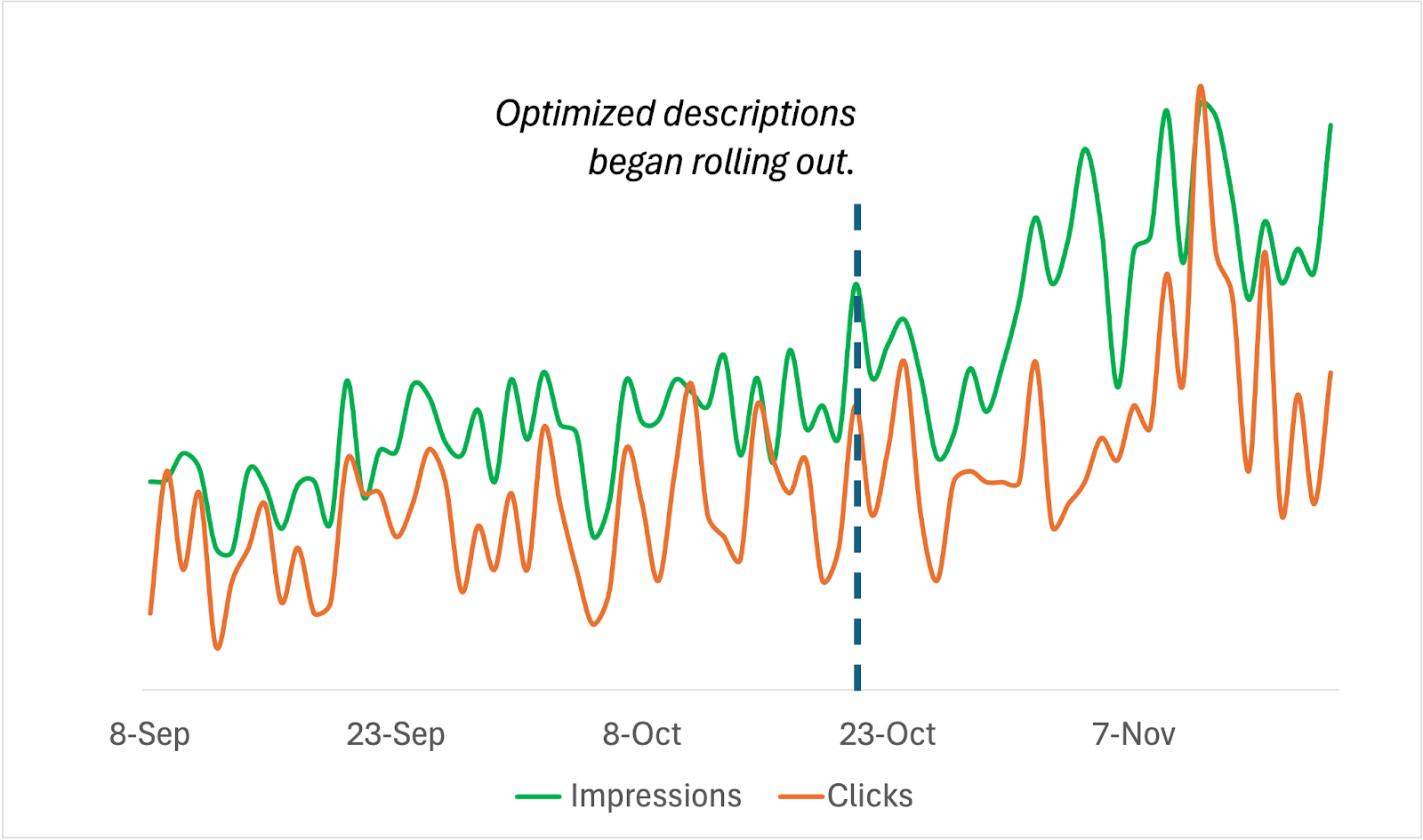
The new descriptions were packaged into a Supplemental Feed for Google Merchant Center to override the original feed inputs. Impact was immediate and measurable:
This AI workflow produced optimized product descriptions that followed best practices, improved ad performance, and maintained accuracy across thousands of listings — all in just a few weeks. It's a repeatable approach that scales to any product catalog size.
Want to see results like these for your business?
Get a Free Strategy Session
Note: Due to our contracts, the client in this case study must be anonymous.
A Philadelphia-based athletic cover manufacturer and retailer partnered with Greenlane to assess its website after a recent re-platform and redesign. Since making site changes, the company experienced low, inconsistent organic traffic on its revenue-driving product category and product pages.
Upon investigation, our team discovered duplicative content causing internal traffic competition and compromising SEO. Many pages had little information or competitive keyword strategy, explaining the lack of organic traffic. It was clear the site needed a serious content overhaul.
Our shared goal was to increase website traffic and engagement rates on the company's most important e-commerce pages. These buy-ready pages lacked the robust content and SEO tactics needed to help users and search engines improve the shopping experience.
We also wanted to enhance the overall buyer's journey — many supportive resources were difficult to find within the site's navigation for shoppers still doing pre-purchase research. This was a missed opportunity to educate shoppers on product benefits and signal to Google that the site offers robust, authoritative content.
We began with a content audit to evaluate the site's categories, products, guides, and resources. Most product category pages had little or no content and needed improvement. There were also canonicalization issues and duplicative query pages splitting organic value.
Our team categorized every page as maintain, optimize, or consolidate/redirect. We organized related content, outlined interlinking opportunities, and layered in keyword research and competitive SERP analysis for a strategic SEO edge.
With client approval, we began optimizing product category pages in March 2023. All recommendations were implemented by mid-May.
The strategic execution paid off with measurable, sustained gains:
Content and SEO optimization to the client's product pages were the keys to unlocking improved site metrics across the board.
Want to see results like these for your business?
Get a Free Strategy Session